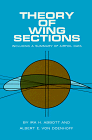
Contrary to my usual practice of begging authors for a free copy of
their book, this review is of a book I actually own! Indeed, I went
to considerable trouble to purchase Abbott and von Doenhoff (A&vD),
back about 12 years ago. It was one of the best and most useful book
purchases I have ever made.
This is a book about the design
and performance of wings: if you intend to design your own airplane,
whether full-scale or model, you need this book. There is plenty
of Maths which some may find useful: for the non-mathematical, just
skip the maths and look at the diagrams, read the text and allow
your brain to soak it all in.
A&vD is now hopelessly out of date, being published
first in 1949, with a new edition in 1958. However, this is part
of its charm. It is still readable, at a level accessible to most,
whereas more modern texts have become progressively more mathematical
and are pitched to the professional graduate Engineer.
The chapters include discussion on the significance of wing-section
characteristics, 2-dimensional flows, theory of wing sections, effects
of viscosity, families of wing sections, experimental characteristics
of wing sections, high-lift devices and compressibility. At least
50% of the book is comprised of airfoil section coordinates and
their aerodynamic polars (lift, drag, pitching moments).
Now I'll skip thru the pages and pull out some gems.
Pages 4 and 5 have graphs showing the effect of Aspect
Ratio on wing characteristics. In model pylon race, for many years
the models had aspect ratios as low as 5. Modern race models have
aspect ratios as high as 9 or higher. I should know, I machined
the moulds for the last F3D world Championship winning model and
did the area calculations to make sure it fitted the rules. And
aspect ratio is simply wingspan-squared divided by area. One glance
at figures 2 and 3 is enough to explain the superiority of the new
wings.
Page 8, equation (1.6) is
CD = cd + Cl^2/(pi*A)
where CD is the drag coefficient of an elliptical
wing of aspect ratio A, cd is the drag coefficient of a wing of
infinite aspect ratio, Cl is the lift coefficient and pi is 3.1412
etc.
Don't be tricked by this equation. The total wing
drag is quite different from the drag coefficient. The induced drag
of the wing does not vary with Cl^2/A, only the coeficient does:
that is a different animal altogether. Barnaby Wainfain in Kitplanes
some time back pointed out that the total induced drag depends on
the span loading, a result that may be derived by substituting eq(1.6)
in eq(1.2).
Page 41 throws up a theorem from Fluid Dynamics theory,
concerning the superposition of flow fields to obtain a resultant
flow field. That is, for a fluid, you add 2 velocity fields together
to get the actual flow around an object. I have never been happy
with this theorem, and would like to display my ignorance and lack
of rigour in this regard.
E.R Jones has suggested application of this theorem
to obtain the flow around a spinner/cowling assembly, with application
to the design of propellers. He uses the flow from 2 sources superimposed
on the free-field flow. By suitable adjustments of the source strengths,
one can obtain a convincing representation of the axial flow velocity
into the propeller as a function of propeller radius. The method
can be generalised to any number of sources, which suggests perhaps
that it could be used to obtain the flow pattern over an airfoil
section. This is drawing a long bow, but it lead me to think a bit
more carefully about the process.
The flow pattern is a set of streamlines. By definition
of a streamline, this means that there is no mass flow across streamlines:
hence there is a continuity constraint on the flow between the streamlines.
The product of mass times velocity (mass flow) must be constant
everywhere within a streamline (near enough, you can make the streamline
infinitely thin).
I did the mass flow calculation for a spinner/cowling
flow representation and was alarmed to find a huge increase in velocity
was required going over the cowling, a figure entirely different
from the simple sum of the source and free-field velocities. It
is not at all obvious to me that some roll of Bernoulli's dice can
sweep this under the proverbial mat. If someone out there has a
nice readable explanation for this, I would love to peruse it.
Chapter 4 is about the theory of thin wing sections.
As a propeller designer, it's most useful part was on the calculation
of the zero-lift angle of an airfoil. While measured section data
is really the only reliable way to go here, there are times, when
doing computer simulations, that a simple formula for zero-lift
angle is most useful. Such a method is given in Section 4.3, involving
a summation of terms involving the section coordinates.
I latched right onto this and got results that were
OK for high Reynolds numbers.
However, R.T. Jones in his book Modern Subsonic Aerodynamics
(which is no more more "Modern" than A&vD) gives an analysis
which provides an extremely simple way of obtaining the zero-lift
angle. It is just the angle between the chord-line and a line joining
the trailing edge to the camber-line high-point.
Calculation by both methods suggests that there is no difference
between the two, for all practical purposes. Hence I ended up using
R.T.'s method, but mainly because he was such a cool guy at high
Mach numbers! I believe he was the first American to appreciate
the joys of swept-back wings.
Moving right along, Chapter 6 introduces the method
the old NACA used to generate their families of wing sections. This
is pure gold! I have only used the equations for the 4-digit sections.
Because my work invariably involves low Reynolds numbers, I have
felt that more advanced sections have little to offer me. I have
been thru Herk Stokeley's Soartech 8 sections, but always return
to NACA 4-digit for ease of use and high-performance in turbulent
flows. Sections such as NACA6409 and NACA4407 have given me good
results. 6409 is the Dixielander section, and I have used 4407 in
F1C at the suggestion of Peter Nash.
My CNC machined propeller moulds are nearly all NACA
4-digit sections, so some pause here may be justified.
The most famous wing section of all-time must be Clark-Y.
Many people may not be aware that the thickness form of Clark-Y
is the basis of the NACA 4-digit sections. All NACA appears to have
done is recognise the good performance of Clark-Y, and fitted their
parameters of camber, camber-line high-point and thickness to chord
ratio to this section. Thus NACA 4412 is very close to Clark-Y.
Clark-Y has 11.72% t/c and camber 3.55%, compared to 4412's 12%
t/c and 4% camber. The camber line high-point is close for both,
at about 40% of x/c.
Variations on 4412 can be expected to have good performance
as well. Just by thinning 4412 to say 4409, one gains considerably
in L/D.
Moving the high-point forward inceases the max L/D for better acceleration
at low speed. Thus the 4-digit sections can be tailored to suit
the design constraints. This is all very nice.
Chapter 9 is about airfoil characteristics at high
Mach numbers. This is the region, nowadays known as the transonic
region, where the compressibility of air and the formation of shock
waves start to dominate the airfoil section performance. At the
time this book was written, aerodynamicists were not up to speed
on these problems. A lot has happened since then. But let us look
at the transonic data in A&vD and check them out with 20/20
vision, ie, lots of hind-sight!!
There are graphs of lift-coefficient and drag-coefficent
versus Mach Number and angle of attack for NACA 4-digit sections
2306, 2309, 2312 and 2315. Remember, the notation for 4-digit sections
tells us that the only difference in these sections is their thickness-to-chord
ratio. Blind Freddie can see that the thicker the sections, the
worse the high-Mach number performance.
Hence the drive to make propeller tip section as thin as possible,
to the point where they need to be impractically thin. About the
only time when high Mach-number problems do not occur in propellers
is the rubber and human powered types.
Now for the hind-sight, which is the most fun. Modern
super-critical airfoil sections are basically like the old sort,
but turned upside down! Yes, most curvature is on the bottom of
the wing, a situation not unlike negative camber!
So let us now do something novel, and turn A&vD's book upside
down and again read the airfoil data. Looking for example at Figure
163, we see that NACA2309 has lousy performance below Mach .7, and
works wonderfully well at Mach .9 !
It was 20 years after A&vD's work that supercritical
airfoils were discovered. If only they had turned the book upside
down, we would have had Jumbo jets in 1955!!
Well by now you have a taste for the delights of this
book. I want to finish on one last point.
I said earlier that the NACA 4-digit sections can
be adapted to many needs. From immediately above, we can see that
they can work at high-Mach numbers. For some time I tried to use
Mark Drela's Xfoil code to analyse my own supercritical sections,
without success. The code would just hang up. It would only run
reliably on the 4-digit sections ! So I set out to optimise the
4-digit sections for Reynolds number and Mach number. I found that
the sections needed to be thin, with a rearward high-point and could
only be run at a few degrees angle of attack. Anyone out there with
the time, how about doing this exercise again, but with negative
camber?
I'm too busy trying to stay in the black, so its up
to you, dear reader.
Oh, and buy the book, you can't go wrong.
|